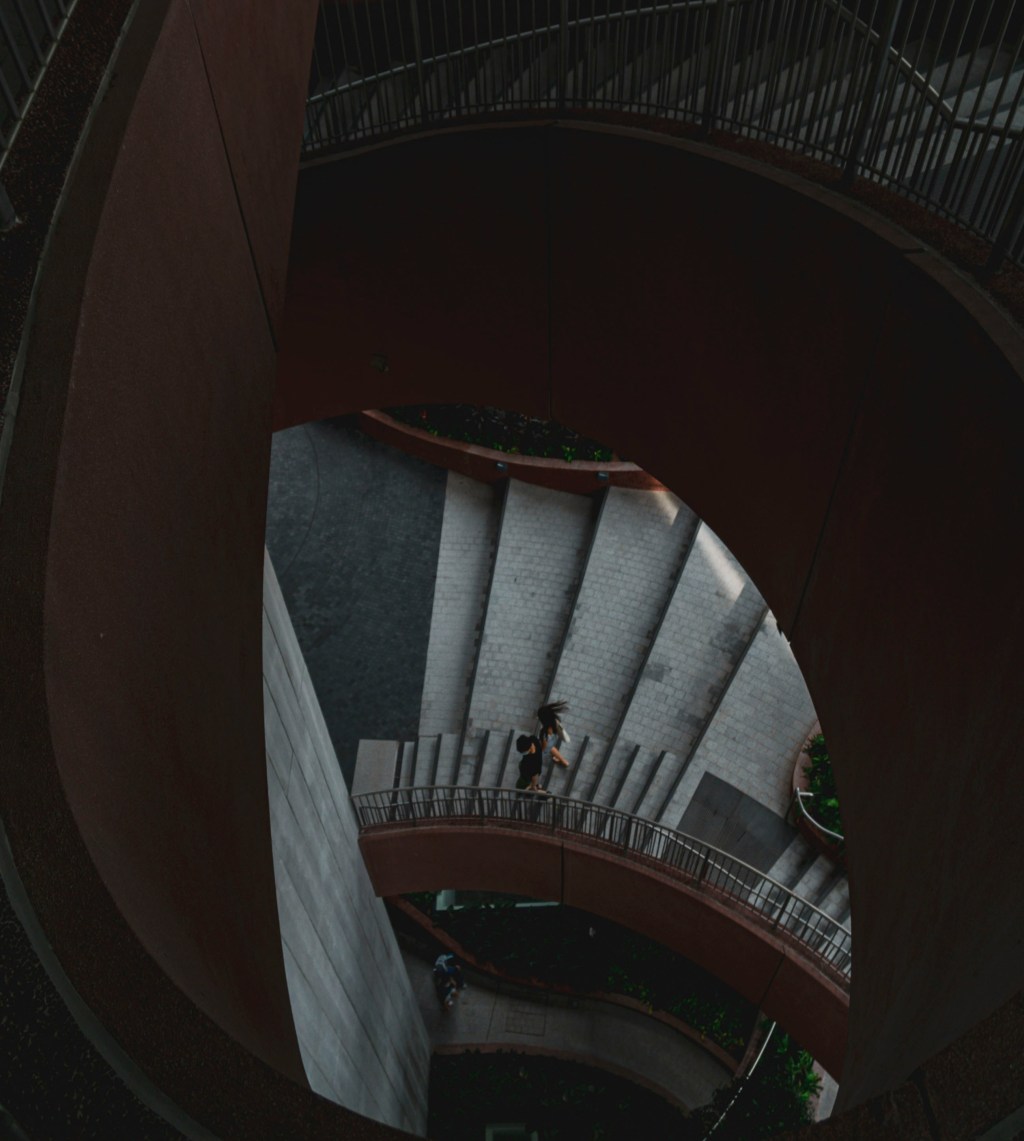
Stand beneath a stone archway and notice how your shoulders fall away from your ears. Now picture a corridor lined with needle-sharp angles: suddenly you lengthen your stride, eager to leave. Long before scanners tracked our heart-rate variability, builders sensed that geometry tilts emotion. Contemporary research now explains why – curves enlist the brain’s comfort circuits, while extreme angles whisper threat – and ancient craftsmen channelled that instinct into barrel vaults, sinuous cornices and gently rounded hearths. In this chapter we follow the arc from neuroscience to colonnade, finishing with a handful of layout tweaks that soften modern boxy rooms.
Curves
Digital-reality labs give volunteers stressful tasks, then “teleport” them into virtual rooms. In one study, switching the same plan from rectangular to curvilinear walls raised positive-affect scores and quickened heart-rate recovery by almost 20% (Science Direct). Follow-up EEG work shows that viewing rounded furniture or openings lights up regions linked to reward and empathy (anterior cingulate, orbitofrontal cortex) – even when colour, lighting, and decor stay constant (Science Direct).
Why doest a curve read as friendly? Evolutionary psychologists suggest two reasons. First, living organisms – from river pebbles to the human face – rarely display perfect right angles, so curves feel familiar. Second, a continuous contour offers no sudden edge that could harbour danger. Greek stonemasons intuited the effect; their Ionic volutes spiral like unfurling ferns, drawing worshippers inward rather than guarding them out.
Angles
A 2008 fMRI paper became famous for showing that V-shaped wedges activated the amygdala – the brain’s threat detector – more than U-shapes did, even when flashed for a fraction of a second (PubMed). Later experiments confirmed that participants rate angular interiors as “dynamic” yet less relaxing than curved analogues and display slight spikes in galvanic-skin response (PMC).
Sharp corners, of course, have their place. In kitchens, worktops and cabinet grids telegraph precision and clarity. Modernist architects used orthogonal plans to proclaim rational progress. The goal is proportion: too many acute edges in a lounge can keep guests mildly vigilant, whereas one crisp rectilinear alcove in a softly curved room can serve as a visual anchor.
Symmetry
Across cultures, people prefer bilaterally balanced shapes; symmetrical facades register as more beautiful, trustworthy and even pro-social in VR walk-through tests (SSRN). Neuro-aesthetics adds that symmetry lowers cognitive load, freeing working memory for other tasks (PMC). Yet perfect mirroring can drift toward formality or stasis – think ceremonial palaces where a whisper feels too loud.
Traditional interiors resolve the tension with dynamic symmetry: a fireplace centred between windows, but shelves arranged 3-5-7 on one side and 2-4-6 on the other. The principle appears in Chinese scholar gardens and in today’s “rule of odd numbers,” which designers champion for coffee-table vignettes because it injects rhythm without chaos (LivingEtc).
Gestalt, Flow & the Way We Read a Room
The Gestalt laws – proximity, continuity, closure – describe how the visual system stitches fragments into wholes. Straight corridors lined with identical doors feel longer (continuity), while a gentle S-bend with alternating alcoves seems shorter and more exploratory (The Interaction Design Foundation). Curves also show walking speed, stretching perceived time inside a gallery or boutique.
In residential projects I often suggest rounding the outer edge of a kitchen island or adding a shallow arch between hallway and living room; both edits soften sight-lines and help the eye glide, which users then experience as “better energy,” even if they can’t explain why.
From Archies to Feng Shui
Chinese Feng Shui warns against sha qi – literally “killing energy” sent by sharp external corners. Medieval cathedrals countered with flying buttresses that arch like welcoming arms, distributing load while guiding pilgrims’ gaze heaven-ward. Even the humble thatched cottage rounds its eaves, shedding rains but also softening the sky-line. Across continents and eras, architects converge on one lesson: people linger where edges yield and exit where edges threaten.
Looking Up
Shape directs emotion along the horizontal plane, but vertical dimension intensifies the effect. A ceiling that soars like a nave breeds contemplation; a low slanted roof can feel either cocooning or claustrophobic. In the next chapter we’ll climb – and occasionally duck – through the psychology of height to see why “cathedral” and “den” provoke such different mindsets, and how modest design tricks can stretch or cosy a space without moving a single joist.
Slip off your shoes this evening and walk one slow lap of home. Notice where you skirt a corner, where you naturally pause. A slight radius here, a realigned picture there, and the perimeter of comfort expands – no blueprint overhaul required.
JG x
About the Author

Hi, I’m Jordan, an interior designer and vintage home decor enthusiast based in the UK. I’m passionate about creating beautifully curated spaces that reflect personal stories and evolving styles. Through my own renovation journey, I’ve learned to embrace the imperfect, the unfinished, and the ever-evolving nature of a home. Join me as I share insights, tips, and a bit of real-life mess along the way!

Loved this insight?
Let’s craft your space.
Sources
Vartanian, O. et al. (2024). The impact of room shape on affective states, heart rate and creativity. Heliyon, 10, e14731. ScienceDirect
Bar, M. & Neta, M. (2008). Visual elements of subjective preference modulate amygdala activation. Neuropsychologia, 46, 2191-2198. PubMed
Choo, H. et al. (2023). The curvature effect: approach–avoidance tendencies in response to architectural forms. Journal of Environmental Psychology, 86, 101928. ScienceDirect
Gestalt Principles overview. Interaction Design Foundation (2016). The Interaction Design Foundation
Kuhn, G. et al. (2025). Does symmetry in architecture promote prosocial behaviour? SSRN preprint. SSRN
Martinović, J. et al. (2025). Neurocognitive dynamics of symmetry processing. Symmetry, 17, 1478. PMC
LivingEtc (2025). The 3-5-7 rule in decorating: why odds feel natural. Livingetc
Architizer (2024). Emotional architecture: how curves and lines influence human experience. Architizer
Bertamini, M. et al. (2019). Symmetry preference in shapes, faces, flowers and landscapes. PeerJ, 7, e7078. peerj.com
 GALATEA
Leave a comment