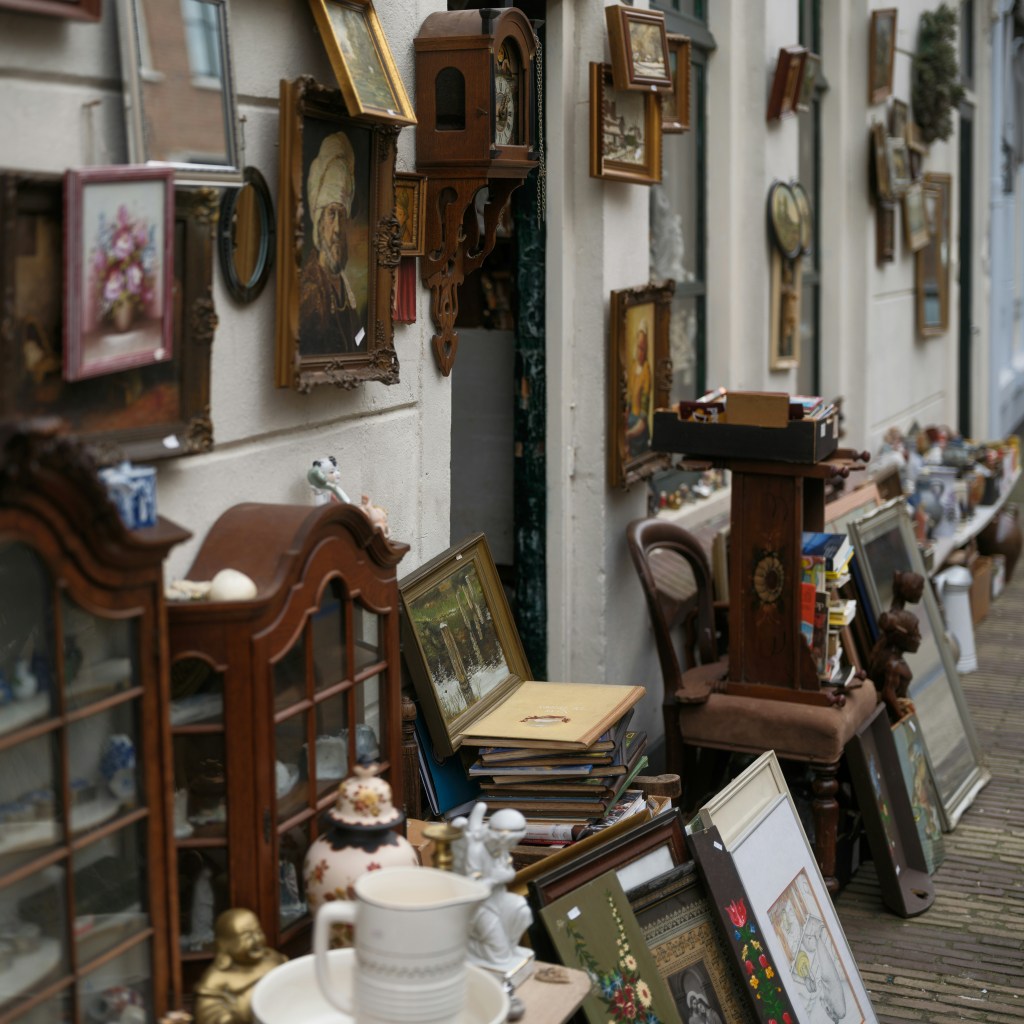
Last week we saw how clear sight-lines and uncluttered layouts calm the nervous system. Yet even the most elegantly zoned plan can still feel hollow if the things inside it ring false. Objects are emotional amplifiers: they cue memory, signal identity, and – even before we notice – tilt our physiology. Vintage hunting is therefore more than a hobby; it is an evidence-backed route to mood regulation and self-continuity.
Nostalgia as an Adaptive Emotion
Psychologists define nostalgia as a bittersweet but largely positive motion that arises when past experiences are recalled vividly. Meta-analyses show it boosts social connectedness, raises optimism, and buffer stress during times of uncertainty (Frontiers; Deseret News). A 2024 Frontiers in Psychology paper even frames nostalgia as a self-continuity tool that helps people knit together past, present, and future identities – particularly important when external conditions feel unstable (Frontiers).
Vintage objects work as memory prosthetics: by carrying visual and tactile cues from earlier eras, they trigger the same neural networks that encode autobiographical memory, turning living rooms into repositories of emotionally charged “time capsules.”
The Dopamine of Discovery
MRI and behavioural studies on “retail anticipation” show that the search phase of shopping activates the brain’s dopaminergic reward pathway more intensely than the moment of purchase itself (Will Seippel). Neuro-economists call this a reward-prediction error: each rummage through a flea-market box widens the gap between expected and actual treasure, supplying a chemical jolt when the unexpected appears. In short, hunting – not merely owning – delivers measurable pleasure.
Scarcity & Perceived Value
Commodity-theory research confirms that rarity inflates perceived worth: items framed as “scarce” are appraised higher on value, status signalling and anticipated satisfaction (eCommons). The effect is intensified when scarcity is authentic (e.g., discontinued 1960s ceramics) rather than artificially imposed (limited-edition reissues). This mechanism explains why a marble coffee table salvaged from an out-of-production Italian maker feels more precious than a mass-market replica, despite identical function.
Effort Intensifies Attachment
Even when a piece is not old, effort itself can inflate affection. The classic 2011 Harvard “IKEA effect” experiments found participants valued self-assembled items up to 63% higher than identical ready-made versions (Harvard Business School). Applied to vintage furniture – where sourcing, transport, and minor restoration demand labour – the same bias means you are statistically likelier to love (and keep) a sideboard you stripped and re-oiled than one delivered in two-day shipping.
Sustainability & Slow Consumerism
Lifecycle analyses show that extending a wooden table’s usable life by just ten years cuts its cradle-to-grave carbon footprint by more than half (coffin-sos.co.uk). Buying second-hand therefore aligns psychological satisfaction with ecological benefit – a win-win increasingly recognised in circular-economy policy.
Conversation Capital & Social Bonding
Objects with back-stories act as conversation catalysts. Marketing scholars note that consumers use distinctive vintage items to display identity narratives and foster social ties – that is, “I own, therefore I share the story” (goizueta.emory.edu). Because these narratives are unique, they strengthen interpersonal connection more than “I got it online” anecdotes.
When Thrifting Goes Wrong – Common Cognitive Traps
- Bargain Blindness – Overweighting low price and ignoring fit; mitigated by a “24-hour rule” before purchase.
- Restoration Overconfidence – Underestimating time or money required; cross-check true cost against new-buy equivalent.
- Collection Creep – Accumulating uncharted items that re-create clutter; conduct quarterly edit sessions and regift to charity.
Bridging Forward
A striking pattern in the literature is how many prized vintage pieces are made of natural materials – oak sideboards, wool rugs, marble tables. These substances deliver sensory richness that synthetic lookalikes rarely match. Next week we zoom in on that very question: how wood grain lowers cortisol, why linen curtains feel cooler to the skin, and what clay plaster does for indoor humidity.
In the meantime, the research is clear: treasure hunts work best when they balance head and heart – evaluating rarity, effort, and ecological gain alongside the simple pulse of recognition when you find the piece that feels like it has always belonged to you.
JG x
About the Author

Hi, I’m Jordan, an interior designer and vintage home decor enthusiast based in the UK. I’m passionate about creating beautifully curated spaces that reflect personal stories and evolving styles. Through my own renovation journey, I’ve learned to embrace the imperfect, the unfinished, and the ever-evolving nature of a home. Join me as I share insights, tips, and a bit of real-life mess along the way!

Loved this insight?
Let’s craft your space.
Sources
Emory Goizueta Business School. (2025, May). Retro appeal: Research reveals the reasons behind vintage shopping in turbulent times. goizueta.emory.edu
Lynn, M., & Harris, J. (2024). Scarcity effects on value: A quantitative review of commodity theory. Cornell University Working Paper. eCommons
Seippel, W. (2023). Retail therapy: The thrill of the hunt. Will Seippel
Coggin Sustainable Office Solutions. (2025). Impact report on reusing and recycling office furniture. coggin-sos.co.uk
Deng, X., & et al. (2024). Emotion and cognition: A cognitive-processing model of nostalgia. Frontiers in Psychology, 15, 1440536. Frontiers
Elsevier Well-Being Institute. (2023). Nostalgia increases mental well-being and social connection. Deseret News
Norton, M., Mochon, D., & Ariely, D. (2011). The “IKEA effect”: When labor leads to love. Harvard Business School Working Paper. Harvard Business School
 GALATEA
Leave a comment