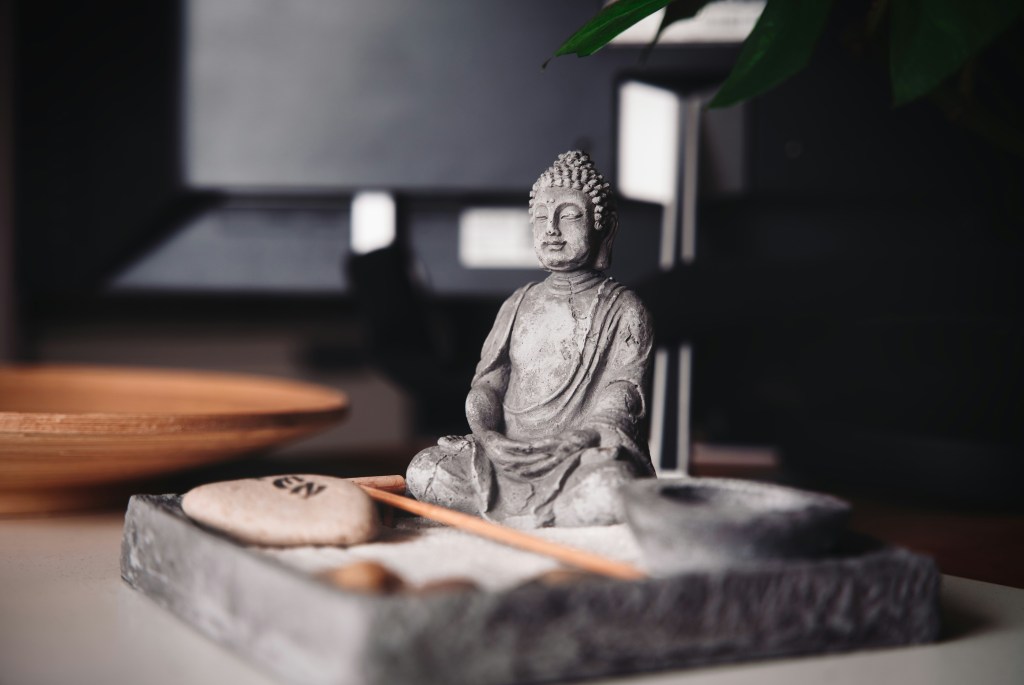
“Our homes are living organisms.” That’s the conviction behind this new six-part series. Over the coming weeks we’ll explore why a curved worktop makes a galley kitchen feel friendlier, how ceiling height changes our thinking, and why that marble table you hunted down at a car-boot sale feels far more “you” than any click-and-collect flat-pack. We’ll braid two threads: ancient wisdom (Feng Shui, Vastu, folk rituals) and modern science (environmental psychology, biophilia, neuroscience). The aim isn’t to prove one side “right” but to reveal how both point us toward the same truth: spaces shape emotions, and emotions, in turn, shape the way we live in those spaces. By the finale, you will know why curved islands soften galley kitchens, how ceiling height nudges creativity, and what makes an entryway a psychological reset button.
What Exactly Is Spatial Psychology?
Environmental psychology, both in the late 1960s when researchers began linking mood to surroundings – studies how light, layout, materials, and even noise affect behaviour and stress levels (Wikipedia).
Modern researchers use salivary cortisol, heart-rate variability and functional MRI to link spatial variables – light, clutter, circulation routes – to stress and mood. In one laboratory experiment, placing participants in deliberately chaotic “household chaos” room elevated perceived stress by 18 percent and dampened caregiving motivation compared with an identical tidy room (PubMed Central).
Neuroarchitecture extends the field with brain-imaging work showing that coherent, visually legible rooms activate the brain’s default-mode network (associated with calm introspection), whereas visually disordered rooms trigger the salience network (vigilance) (Collarts). In short, our nervous system is constantly “reading” interiors and modulating hormones accordingly.
Layout, Clutter, & Cortisol
Multiple studies converge on one takeaway: clear paths and low visual noise reduce physiological arousal. A Verywell Mind meta-analysis reports that excessive household clutter is correlated with higher cortisol, difficulty focusing, procrastination and lower life satisfaction (Verywell Mind). Experimental work on furniture layouts finds that participants rate rooms with unobstructed circulation routes as significantly more “inviting” and “restful” than those with blocked pathways – even when decor and colour are identical (Home Reserve).
Design implication: treat floor-space like negative space in graphic design. The gap between sofa and coffee table, or between kitchen island and range, is not “unused” real estate; it is the route through which bodies (and heart-rates) move smoothly.
Feng Shui – Principles vs Evidence
Feng Shui (literally “wind-water”) is a 2,000-year-old Chinese system that prescribes orientation, object placement, and elemental balance to optimise qi or life energy. Typical rules – do not align a bed with the door, keep artwork from looming over sleepers, avoid sharp ‘poison arrows’ – map neatly onto modern safety and comfort heuristics.
A 2023 systematic review located 23 quantitative studies testing Feng Shui interventions. Results were mixed: while no study confirmed an independent qi mechanism, several found that Feng Shui-based layouts improved occupants’ subjective comfort and spatial satisfaction compared with random layouts (PubMed Central). Critics note that these gains are fully explainable by conventional ergonomics or aesthetic factors; nonetheless, the review concludes that Feng Shui recommendations “overlap substantially with evidence-based environmental-psychology guidelines” (PubMed Central).
Key overlaps with science:
| Feng Shui Precept | Corresponding Empirical Finding |
| Clear front-door sight-lines (no clutter) | Lower cortisol and smoother way-finding in decluttered entry zones |
| Bed in “command position” (view of door, head supported) | Reduced nighttime arousal when sleepers see exits without being in direct line of traffic |
| Balance five elements (wood, earth, metal, water, fire) | Higher aesthetic-pleasure ratings in rooms with varied textures and materials |
The upshot: Feng Shui’s cultural framing differs from lab science, but many prescriptions parallel measurable benefits – especially those that minimise unconscious threat cues (falling objects, blocked escape routes, sharp edges).
Evidence-Based Flow Checklist
Drawing on the studies above, the following five actions deliver the greatest stress-reduction “ROI” without major building work:
- Maintain a 90cm minimum circulation band in high-traffic areas. Improves perceived legibility and reduces collision anxiety (Home Reserve).
- Keep entry vestibules visually uncluttered. First impressions set stress baselines; a tidy threshold lowers sympathetic-nervous activation after outside exposure (Verywell Mind).
- Anchor beds and primary seating on solid walls with lateral clearance and a diagonal view of the door. Mirrors the “prospect-refuge” pattern shown to heighten comfort in biophillic studies (Collarts).
- Avoid over-head mass above rest zones. Heavy shelves or art directly above beds can raise startle response and disrupt sleep continuity (Collarts).
- Introduce material variety (wood, stone, fabric) at human-touch points to enrich sensory input and offset monotony – validated in studies linking textured, multi-material rooms to mood elevation (Collarts).
Convergence: Tradition Meets Neuroscience
Taken together, environmental-psychology metrics and traditional flow systems recommend remarkably similar move: prioritise clear routes, balanced sight-lines, and tactile diversity. Where they diverge – qi maps, auspicious compass bearings – evidence is currently insufficient; yet even here the placebo effect can harness expectation to reduce stress. Perceived order can be as soothing as objectively measured order, provided it does not conflict with ergonomics.
Looking Ahead
Objects carry stories, memories and social cues that influence mood as powerfully as layout. Chapter 2 will examine the psychology of vintage hunting and nostalgia, revealing why a marble side-table sourced at dawn in a car-boot field can spark more joy than a brand-new showroom set – and how to judge thrift finds with both heart and evidence-based head.
Until then, consider performing a five-minute audit: walk from your front door to your bedroom, noting every moment the path narrows, sight-lines break, or overhead items hover. Small adjustments here are the first, research-supported step toward a calmer, cognitively lighter home.
JG x
About the Author

Hi, I’m Jordan, an interior designer and vintage home decor enthusiast based in the UK. I’m passionate about creating beautifully curated spaces that reflect personal stories and evolving styles. Through my own renovation journey, I’ve learned to embrace the imperfect, the unfinished, and the ever-evolving nature of a home. Join me as I share insights, tips, and a bit of real-life mess along the way!

Loved this insight?
Let’s craft your space.
Sources
Saxbe, D. E., & Repetti, R. L. (2010). No place like home: Home tours correlate with daily patterns of mood and cortisol.Personality and Social Psychology Bulletin, 36(1), 71-81. PubMed
Roster, C. A., Ferrari, J. R., & Jurkat, M. P. (2016). The dark side of home: Assessing possession “clutter” on subjective well-being. Journal of Environmental Psychology, 46, 32-41. ScienceDirect
Han, K-T., & Lin, J-K. (2023). Empirical and quantitative studies of Feng Shui: A systematic review. Heliyon, 9(9), e19532. https://doi.org/10.1016/j.heliyon.2023.e19532 PubMed
Bonaiuto, M., Bilotta, E., & Stolfa, A. (2010). “Feng Shui” and environmental psychology: A critical comparison. Journal of Architectural and Planning Research, 27(1), 23-34. Scribd
Coburn, A., Vartanian, O., & Chatterjee, A. (2017). Buildings, beauty, and the brain: A neuroscience of architectural experience. Journal of Cognitive Neuroscience, 29(9), 1521-1531. PubMed
Kim, Y.-J., & colleagues. (2023). Exploring the relationship between home environmental characteristics, restorative potential and neural activity using Neu-VR. International Journal of Environmental Research and Public Health, 20(1), 1-17.
 GALATEA
Leave a comment