Hello design lovers,
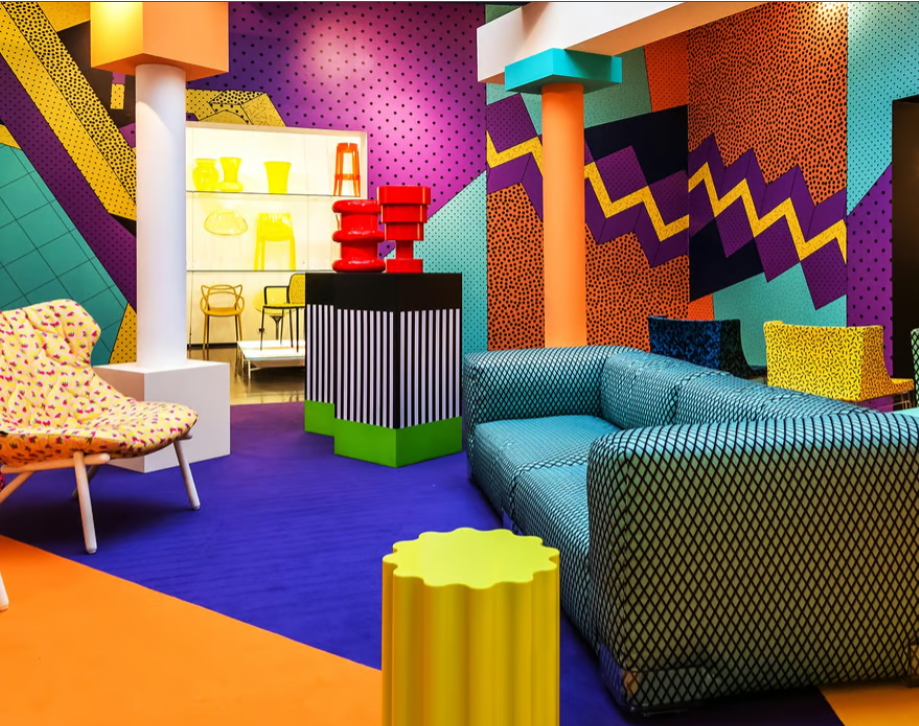
As we trace the dynamic contours of interior design history, postmodernism stands out with its vibrant defiance against the stoic minimalism of modernism.
Emerging in the late 20th century, this style heralded a departure from the austere functionalities that had previously dominated the field. It was a movement that welcomed back whimsy, ornamentation, and an eclectic medley of styles, making it a turning point that redefined aesthetic norms in interior spaces.

Postmodernism, sprouting in the late 1970s and flourishing through the 1980s, brought forth a palette of vibrant colours, bold patterns, and a penchant for playful, whimsical forms.
The Rise of Postmodernism
The roots of postmodernism are deeply embedded in a growing disillusionment with the modernist dogma by the 1970s, perceived as elitist and oversimplified. Pioneers like Robert Venturi led the charge against this orthodoxy. His seminal texts, “Complexity and Contradiction in Architecture” (1966) and “Learning from Las Vegas” (1972), critiqued the lack of nuance in modernist approaches and advocated for a richer dialogue between historical references and contemporary design. Venturi’s advocacy for diversity and visual complexity laid the foundational ethos of postmodernism.

Italy soon became a pivotal arena for this burgeoning movement, with figures such as Alessandro Mendini and Ettore Sottsass driving the avant-garde. Mendini’s Proust Chair and Sottsass’ Memphis Group became emblems of postmodern design, challenging conventions with their audacious colours and innovative forms.
Defining the Postmodern Aesthetic

Postmodern interior design is distinguished by several key characteristics:
- Eclecticism and Contradiction: This style thrives on the juxtaposition of disparate design elements, merging traditional with modern, and high culture with pop-art, creating a vibrant tapestry of aesthetic delight.
- Bold Colours and Patterns: Gone were the days of subdued palettes, as postmodernism embraced saturated hues and daring patterns that stood defiantly against the monochromatic modernism.
- Playfulness and Whimsy: With a nod to the nonsensical, postmodern design reintroduced humor and irony through whimsical decor and furniture that dared to stand out.
- Complexity and Asymmetry: Rejecting the clean lines and balanced forms of its predecessor, postmodernism celebrated complex, asymmetric designs that captivated the eye and provoked thought.
- Varied Materials and Textures: Designers mixed unlikely materials and textures, blending the industrial with the luxurious, the rough with the smooth, embodying the postmodern spirit of innovation.
- Historical References with a Twist: Classic motifs were reimagined, often used playfully or exaggerated to fuse the past’s grandeur with the present’s boldness.
Visionaries and Iconic Creations

Notable designers such as Alessandro Mendini with his Proust Chair, Ettore Sottsass with the Memphis Group’s Carlton Bookcase, and Michael Graves with his Whistling Bird Tea Kettle, each contributed uniquely to the rich tapestry of postmodernism. Their works not only challenges the prevailing norms but also encouraged a deeper exploration of form, function, and the very essence of design.
Cultural Impact and Legacy

Despite facing criticism for its perceived superficiality and sometimes chaotic expressions, postmodernism has undeniably left a deep imprint on the design landscape. Its principles continue to influence contemporary design, allowing for a more liberated and imaginative approach to creating spaces. Moreover, the current resurgence in postmodern elements within interior design underscores its lasting appeal and relevance.
Conclusion
The legacy of postmodern interior design is a testament to its transformative power in the history of aesthetic expression. By breaking free from the constraints of modernism, it has championed a more diverse, vibrant, and dynamic approach to design that continues to inspire and provoke.
As we continue to explore and appreciate various design movements on our platform, I encourage you readers to delve into other articles that shed light on different styles and epochs, to enrich your understanding of interior design’s eclectic nature.
JG x
Resources
- Alessi (no date) 9093 Kettle. Available at: https://uk.alessi.com/products/9093-kettle?variant=33749660237955&tw_source=google&tw_adid=&tw_campaign=17689280574&tw_source=google&tw_adid=&tw_campaign=17689280574&gad_source=1&gclid=CjwKCAjw74e1BhBnEiwAbqOAjEzPs7_06eRukeJL6ooC75JQ6KN_G3l-Uz4iVLb_Nt4gF1vPeU5T8hoC_vYQAvD_BwE (Accessed: 25 July 2024).
- Ceros (no date) Memphis Group: Milan Guide. Available at: https://www.ceros.com/inspire/originals/memphis-group-milan-guide/ (Accessed: 25 July 2024).
- Dezeen (2015) Postmodernism architecture: Portland Municipal Services Building by Michael Graves. Available at: https://www.dezeen.com/2015/09/12/postmodernism-architecture-portland-municipal-services-building-michael-graves/ (Accessed: 25 July 2024).
- Design Museum (no date) Alessi 9093 Teakettle. Available at: https://designmuseum.org/discover-design/all-design-objects/alessi-9093-teakettle (Accessed: 25 July 2024).
- Metropolitan Museum of Art (no date) Object 486989. Available at: https://www.metmuseum.org/art/collection/search/486989 (Accessed: 25 July 2024).
- Philadelphia Museum of Art (no date) Object 107519. Available at: https://philamuseum.org/collection/object/107519 (Accessed: 25 July 2024).
- Architecture.com (no date) Explore architecture: Postmodernism. Available at: https://www.architecture.com/explore-architecture/postmodernism (Accessed: 25 July 2024).
- LoveToKnow (no date) Post-modern interior design. Available at: https://www.lovetoknow.com/home/design-decor/post-modern-interior-design (Accessed: 25 July 2024).
- Interior Design Edu (no date) Post-modernism. Available at: https://interiordesignedu.org/post-modernism/ (Accessed: 25 July 2024).
- Houzz (no date) Postmodern design: What is it really. Available at: https://www.houzz.com.au/magazine/postmodern-design-what-is-it-really-stsetivw-vs~28703750 (Accessed: 25 July 2024).
- The Design Build Vault (no date) What is post-modern interior design? Step by step. Available at: https://thedesignbuildvault.com/what-is-post-modern-interior-design-step-by-step/ (Accessed: 25 July 2024).
Get new content delivered directly to your inbox
-

The Interior Life of the Closet
A psychological dissection of the storage lie. This essay argues that the modern obsession with seamless, integrated, invisible storage is an architectural attempt to deny our consumerist reality. We critique the walk-in wardrobe as the last sanctuary—the only truly private room remaining in the open-plan home—where the inhabitant is finally permitted to hoard, display, and…
-
The Anxiety of the Open Concept
A ruthless dissection of the modern open-plan home. This essay argues that the dissolution of walls is a symptom of a society that prioritizes surveillance and perpetual productivity over the right to privacy and retreat. We critique the open concept as an architectural mandate designed to keep family members, guests, and workers in a constant…
-

The Tyranny of the Pure Surface
A philosophical takedown of the pursuit of sterile perfection. This essay critiques the obsessive use of unforgiving, high-maintenance surfaces (Carrara marble, ultra-white quartz) in the modern kitchen. We argue that the material’s impracticality is the point: it’s a luxury status symbol requiring endless maintenance, serving as a constant, expensive performance of aspirational hygiene and total…
 GALATEA
Leave a comment